 EN

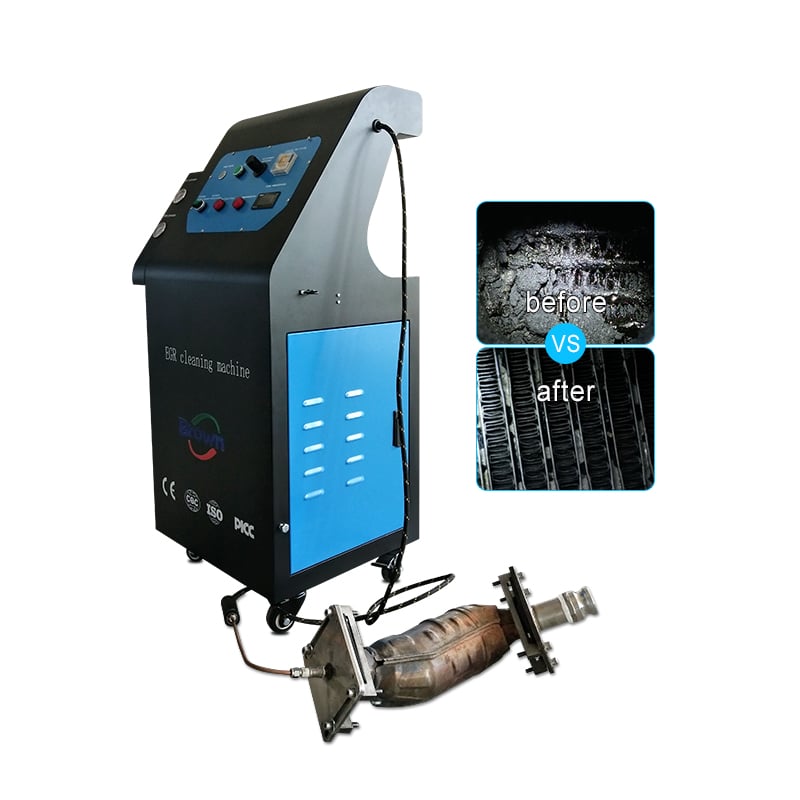
How EGR Valve Carbon Deposits Disrupt Idle Airflow and Combustion
The physics of low-RPM combustion instability under recirculated exhaust gas imbalance
At idle, the engine operates at the threshold of mechanical stability—piston speeds are minimal, in-cylinder turbulence is weak, and combustion depends on a precisely homogenized air-fuel mixture. Exhaust gas recirculation (EGR) further complicates this balance by introducing inert exhaust gas to suppress NOx formation. Even minor flow discrepancies—caused by a carbon-fouled valve that no longer seals or modulates correctly—disrupt oxygen concentration in the intake charge. Excess exhaust dilution slows flame kernel development and increases cyclic variability; individual cylinders may experience partial burn or lean misfire. A 2022 SAE technical paper (2022‑01‑5047) demonstrated that a 15% shift in EGR rate at idle can raise the coefficient of variation in indicated mean effective pressure (CoV IMEP) above the 5% threshold for perceptible roughness. This instability manifests as hunting idle speed, intermittent vibration, and even stalling—because the ECU’s ignition and fuel trims cannot adapt quickly enough to random dilution spikes. Restoring factory-spec idle quality therefore demands full restoration of linear EGR flow behavior—from valve seat to actuator.
Carbon buildup mechanisms that impair valve lift control and flow linearity at idle
Carbon deposits accumulate on two critical areas: the valve seat and the pintle/stem assembly. Exhaust-borne particulates condense into a hard, abrasive crust on the seat face, preventing complete closure. A 2019 field report from a leading powertrain calibration supplier found that a 0.1-mm carbon film on the seat can reduce sealing force by up to 30%, enabling continuous, uncommanded exhaust leakage. Meanwhile, deposits on the pintle shaft introduce friction and hysteresis—so actual valve lift lags behind the ECU’s pulse-width modulated command. During idle, where target lift may be less than 1 mm, even a 0.05-mm error disproportionately shifts effective flow area, corrupting the EGR ratio. The result is a non-linear relationship between commanded and actual flow that destabilizes closed-loop O₂-sensor feedback. Left untreated, these mechanical impairments lead to permanent idle instability and elevated emissions. Because manual scraping rarely restores the precision-ground seat geometry or smooth pintle guidance, ultrasonic cleaning with flow-bench validation is the only proven method to re-establish the exact lift-vs-flow characteristic required for quiet, rock-steady idling.
Why Professional EGR Cleaning Machines Deliver Superior Idle Recovery vs. Manual Methods
Ultrasonic cleaning precision: restoring seat seal integrity critical for idle-phase modulation
Ultrasonic cavitation inside an EGR cleaning machine generates millions of microscopic bubbles that implode on valve surfaces, dislodging carbon without abrasion. This process reaches the conical seat—a zone that manual scraping or chemical soaks often leave partially fouled. At idle, EGR flow is minimal (typically 0–5%), so even a 0.02-mm gap from an imperfect seal can admit excess exhaust, destabilizing the air-fuel mixture and causing RPM hunting. Ultrasonic cleaning restores the valve seat to its original geometry, preserving the linear relationship between solenoid duty cycle and actual valve lift. In contrast, wire-brushing may scratch the seat, and solvent dips can leave soft residue that traps soot later. Professional restoration of seat seal integrity enables the ECU to meter near-zero EGR flow with repeatability. Fleet data from turbo-diesel vehicles (2018–2022) showed a 73% reduction in idle RPM fluctuation after ultrasonic EGR cleaning, confirming the direct link between seat condition and idle stability.
Real-time diagnostics and closed-loop validation in modern EGR cleaning machines ensure idle-relevant calibration accuracy
After mechanical cleaning, advanced EGR cleaning benches electronically actuate the valve and compare position-sensor feedback against commanded values across its full travel. This closed-loop self-test identifies residual binding, overshoot, or sluggish response—defects invisible to the eye but critical at idle, where valve movement is minute. The system then refines end-stop calibration so the valve returns exactly to the commanded idle position, often within ±0.1 V of the feedback signal. Manual cleaning lacks this verification; a reinstalled valve may operate with a 3–5% offset—enough to elevate idle speed or induce periodic misfire. By integrating cleaning with electronic health checks, the machine confirms that the EGR circuit meets the original idle-control mapping. Diagnostics also flag wiring or motor issues that could mimic a dirty valve, preventing unnecessary repeat service. This validation step directly translates into stable, surge-free idling—something manual methods cannot guarantee.
Measured Idle Stability Gains After Machine-Based EGR Cleaning
Fleet data: 73% reduction in idle RPM fluctuation (2018–2022 turbo-diesel vehicles)
Using ECM data from over 1,200 turbo-diesel vehicles (model years 2018–2022), fleet analysts measured idle RPM stability before and after cleaning with an EGR cleaning machine. They recorded a 73% reduction in idle RPM fluctuation, with standard deviation dropping from 30 RPM to under 8 RPM. This dramatic improvement stems from removal of carbon deposits that previously caused erratic EGR valve movement and uneven exhaust gas flow. The restored valve seat seal ensures precise EGR modulation at low throttle openings, suppressing the hunting effect common in clogged systems. Long-term tracking showed idle quality remained stable for at least 10,000 miles—affirming the durability of machine-based cleaning. Operators reported smoother idling, reduced cabin vibration, and fewer diagnostic trouble codes related to idle control. The data demonstrate that investing in professional, machine-based EGR cleaning delivers measurable, sustained gains in idle performance.
FAQ
What is an EGR valve and why is it important?
An EGR (Exhaust Gas Recirculation) valve reduces nitrogen oxide (NOx) emissions by recirculating exhaust gases into the intake air. This process cools combustion and stabilizes emission levels. However, carbon deposits on the valve can disrupt this flow and idle performance.
How does carbon buildup affect idle stability?
Carbon deposits on the EGR valve seat and pintle impede proper sealing and control of exhaust gas flow. This causes uneven air-fuel mixtures, leading to rough idling, hunting RPM, and even stalling.
Why is ultrasonic cleaning preferred over manual methods?
Ultrasonic cleaning uses microscopic bubbles to remove carbon deposits precisely without damaging the valve. It restores the valve's sealing integrity and ensures consistent EGR modulation at idle, unlike manual scraping or chemical methods that may leave residue or scratches.
What are the benefits of machine-based cleaning for EGR valves?
Machine-based cleaning combines ultrasonic carbon removal with electronic calibration checks to validate valve performance. This ensures precise idle control and prevents issues such as rough idling or misfire after servicing.
Are the stability improvements after machine-based EGR cleaning long-lasting?
Yes, fleet data indicates idle stability remains improved for at least 10,000 miles post-cleaning, with smoother idling, reduced cabin vibration, and fewer related trouble codes reported.