 EN

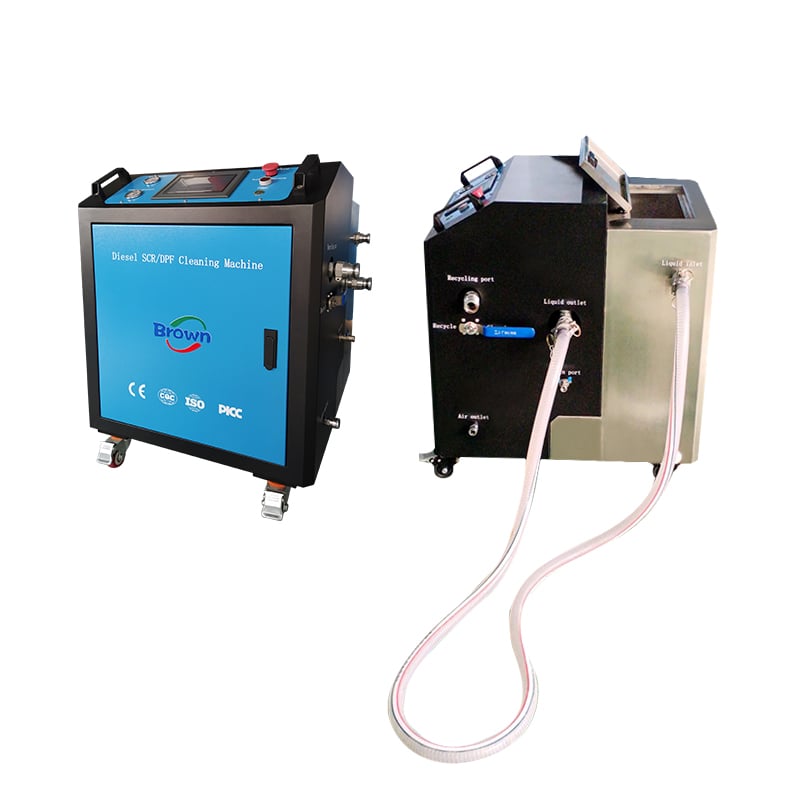
Thermal, Ultrasonic, and Pneumatic Cleaning Mechanisms Explained
Modern DPF cleaning relies on three complementary physical principles to restore filtration performance without damaging the ceramic substrate. Each mechanism targets a specific contaminant type, and their sequential application defines the core of a professional-grade cleaning cycle.
| Cleaning Mechanism | Operating Principle | Contaminant Target | Key Process Parameter |
|---|---|---|---|
| Thermal Decomposition | Controlled high-temperature oxidation | Soot (carbonaceous) | Ramp-controlled 500–650 °C |
| Ultrasonic Cavitation | High-frequency sound waves in liquid bath | Ash (non-combustible) | Frequency 25–40 kHz |
| Pulse Air Backflushing | Reverse-direction compressed-air pulses | Dislodged debris | Pressure 6–10 bar |
Thermal Decomposition: Controlled Oxidation of Soot at Precise High Temperatures
A diesel particulate filter cleaning machine begins with thermal decomposition—the only method capable of eliminating carbon-rich soot trapped in the inlet channels. Soot oxidises fully between 500–650 °C, but uncontrolled heating risks thermal shock, especially in cordierite and silicon carbide substrates, which can crack under rapid temperature gradients. To prevent this, equipment uses adaptive ramp control, raising temperature gradually—typically 5–10 °C per minute—until the target plateau is reached. Oxygen concentration is held at 10–15 % during the plateau to sustain steady oxidation without triggering exothermic runaway that could fuse ash into hard plugs. In-chamber thermocouples monitor the DPF core in real time, and the cycle ends once exhaust gas opacity stabilises near baseline. A 2020 SAE technical paper documented that a properly calibrated thermal cycle removes over 95 % of soot mass in under 40 minutes, regardless of substrate material. After cooling, the DPF is soot-free—but non-combustible ash, often constituting half the total contaminant mass in high-mileage units, remains intact and requires ultrasonic removal.
Ultrasonic Cavitation: Targeted Dislodgement of Ash from DPF Microchannels
Ash—mineral-based, non-combustible residue—clings tenaciously to channel walls and cannot be removed by heat alone. In this stage, the DPF is immersed in a water-based surfactant solution. Transducers bonded to the tank floor generate high-frequency sound waves (25–40 kHz), propagating through the liquid to create microscopic cavitation bubbles. When these bubbles collapse near the substrate surface, they release intense, localised energy jets that mechanically scrub ash from microchannel walls without eroding ceramic or silicon carbide. Lower frequencies (25–30 kHz) offer deeper penetration for larger DPFs; higher frequencies (35–40 kHz) deliver finer resolution in tight cell structures. Independent lab testing cited in a 2022 industry white paper confirmed consistent ash removal exceeding 97 % after a 25-minute cycle for cordierite substrates. The process preserves washcoat integrity and catalytic functionality—making it safe for coated diesel oxidation catalysts (DOCs) and selective catalytic reduction (SCR) units commonly integrated upstream.
Pulse Air Backflushing: Dynamic Flow Reversal to Restore Filter Permeability
The final step applies pulse air backflushing to expel dislodged debris and verify flow restoration. Compressed air (6–10 bar) is delivered via a manifold sealed against the DPF outlet face. Short, high-energy bursts—0.1-second pulses repeated every second—reverse normal exhaust flow, driving air backward through cleaned channels. The transient pressure wave lifts residual ash or condensate from pores and carries it out through the inlet face, where a vacuum extraction hood captures it. Nozzles are staggered across the outlet diameter to ensure uniform coverage and eliminate dead zones. Many systems integrate this step immediately after ultrasonic cleaning while the DPF remains wet, using the water film as a transport medium. Post-backflushing, a differential pressure sensor confirms permeability has returned to within 10 % of the OEM-specified clean baseline—a dynamic validation gate that certifies readiness for reinstallation.
Key Subsystems of a Diesel Particulate Filter Cleaning Machine
A diesel particulate filter cleaning machine depends on precisely engineered subsystems that work in concert to safely remove soot and ash without damaging fragile ceramic substrates. Two critical modules—the thermally controlled heating chamber and the tuned ultrasonic transducer array—demonstrate how adaptive control and material-optimized energy coupling directly determine cleaning effectiveness and filter longevity.
Heating Chamber with Adaptive Ramp Control to Prevent Ceramic Thermal Shock
Ceramic DPF substrates—commonly cordierite or silicon carbide—are highly susceptible to thermal stress. A sudden temperature gradient exceeding 150°C can induce microcracking, compromising structural integrity and long-term durability. The heating chamber employs adaptive ramp control to raise internal temperature gradually, typically no faster than 5°C per minute, until reaching the optimal soot oxidation window of 550–600°C. This rate enables uniform thermal expansion across the honeycomb structure. Real-time feedback from embedded thermocouples dynamically adjusts heater output, preventing local hot spots. A sustained plateau at target temperature for 60–90 minutes ensures complete carbon burn-off, while the closed-loop system also governs cool-down to mitigate residual thermal shock upon filter removal. Such precision is indispensable in high-volume service environments, where consistent thermal management directly supports filter longevity, customer cost control, and operational throughput.
Tuned Ultrasonic Transducer Array for Efficient Energy Coupling into Cordierite/SiC Substrates
Ultrasonic cleaning depends on cavitation—the formation and violent collapse of microscopic bubbles in liquid—to dislodge compacted ash from DPF microchannels. For cordierite and silicon carbide, effective energy transfer hinges on matching transducer frequency to the acoustic impedance and resonance characteristics of each substrate. A tuned array operating at 20–25 kHz delivers high power density into the cleaning bath, with transducers positioned to establish a uniform standing wave field across the tank. This configuration ensures deep penetration into channel walls—even at plugged ends—while an impedance-matching network dynamically compensates for shifts in water temperature and filter saturation. In practice, a well-tuned system restores over 95% of original flow capacity, verified by post-cleaning backpressure tests. Because silicon carbide’s higher stiffness demands different energy thresholds than cordierite, the array must be recalibrated per substrate type: insufficient energy leaves ash behind; excessive energy risks erosion of thin channel walls. Proper tuning thus balances thoroughness with substrate safety.
Quantifying Cleaning Efficacy: Industry-Validated Performance Metrics
Validating the performance of a diesel particulate filter cleaning machine relies on objective, repeatable metrics—not visual inspection. The primary benchmark is gravimetric soot and ash removal: a legally compliant filter must achieve ≥85% extraction efficiency to meet OEM tolerances. Pre-cleaning dry weight is recorded on a certified scale to the nearest gram; post-cleaning weight confirms absolute mass removed. This method, aligned with ISO 22987 testing proposals, enforces a residue tolerance below 0.1 g/L of filter volume for Euro VI-certified units (2023 update).
The second critical metric is backpressure restoration—measured as differential pressure drop across the substrate at a fixed exhaust flow rate. A severely plugged DPF may exceed 30 kPa pre-cleaning, imposing significant engine load. After full thermal-ultrasonic-pneumatic treatment, the target is to restore backpressure to within 5% of the OEM clean-sheet value. This metric directly correlates with fuel economy recovery: every 10 kPa reduction lowers fuel penalty by ~1% in heavy-duty diesel cycles. A short flow-bench test verifies permeability matches original geometric porosity—confirming no compacted ash “heel” remains in channel corners.
| Metric | Pre-Cleaning Sample Value | Post-Cleaning Target | Test Method Equivalence |
|---|---|---|---|
| Dry Mass (DPF only) | 8.450 kg | ≤ 7.310 kg (≥ 85 % particulate removal) | Gravimetric balance ISO 11841 |
| Backpressure at 600 m³/h | 28.4 kPa | ≤ 9.8 kPa (matching OEM clean-sheet) | Hot-wire anemometer flow bench |
| Flow Restoration Ratio | 0.62 (62 % of new flow) | ≥ 0.95 (95 % of new flow) | Darcy-Forchheimer permeability |
Optical borescope certification serves as a secondary pass/fail check: even gravimetrically accurate cleaning may leave a translucent glaze layer invisible on a scale. Inspectors advance a 5 mm articulating probe through each channel and rate remaining plug density against a standardised 0–5 grid. Grade 0 indicates no visible deposit—confirming ash has been fully cavitated and expelled. Together, gravimetric precision, flow-dynamic restoration, and optical validation provide a comprehensive, repeatable assurance that the machine consistently returns DPFs to full service life.
FAQs about DPF Cleaning Mechanisms
What contaminants does DPF cleaning target?
DPF cleaning targets two primary contaminants: soot (carbon-rich residue) and ash (non-combustible mineral residue).
Why is thermal decomposition used first in DPF cleaning?
Thermal decomposition is used first because it effectively oxidises and removes carbon-rich soot, which cannot be dislodged mechanically or chemically.
How does ultrasonic cavitation remove ash?
Ultrasonic cavitation generates microscopic bubbles that collapse near the surface of the DPF channels, releasing intense energy jets to dislodge compacted ash without damaging the substrate.
What role does pulse air backflushing play in DPF cleaning?
Pulse air backflushing expels dislodged ash and debris after ultrasonic cleaning, ensuring restored permeability of the DPF channels.
How is the performance of a DPF cleaning machine validated?
Performance is validated through gravimetric soot/ash removal metrics, backpressure restoration tests, and optical borescope certification.